 |
|||||
|---|---|---|---|---|---|
 |
LodiFacing Lodi’s recently revitalized downtown from across the railroad tracks are two blocks of historic structures that served as the hub for Japanese immigrants from the late 19th century up until WWII. Beginning with small numbers of immigrants in the 1880s, local Nikkei numbered over fifty residents by 1902. Four years later, they established a Japanese Association tied to headquarters in San Francisco and branches throughout the state. Connections between Japanese immigrants were reinforced in places like Lodi, where the Japanese enclave served local Nikkei and those who were engaged in agricultural work throughout the fertile San Joaquin Delta region. By 1910, Lodi’s Japantown was thriving next to the Union Pacific railroad tracks, icehouses and packing sheds that shipped the area’s fruits and vegetables across the United States. On Main Street, Nikkei hotels, stores, restaurants, pool halls and bathhouses were intermingled with establishments run by Chinese immigrants. Japantown businesses offered an economic base for the town’s Nikkei and familiar goods and services to the thousands of seasonal grape pickers who worked in regional vineyards. By 1940, the area’s approximately 800 Japanese residents had created a Nihonmachi that included a Buddhist Church and many social organizations, four general stores and a fish market, a drug store, six restaurants, a pool hall, a tofu maker, a laundry, and five hotels. ›› CLICK TO ENLARGE.
PROFILES
| ||||
 Historic Japantowns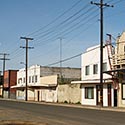
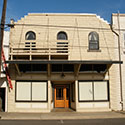
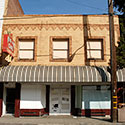

Preserving California's Japantowns has found a remarkable collection of intact historic structures in Lodi, and an equally remarkable group of local volunteers who have identified a potential historic district and begun to raise awareness about Lodi's Japanese American heritage. These two blocks of Main Street represent the most concentrated and intact collection of historic structures newly identified by the PCJ statewide survey. We are immensely grateful to Kathy Ikeda, Suga Moriwaki, Kiyomi Hoxie and Karen Clementi for their diligent and creative work and to the San Joaquin County Historical Society & Museum and the Lodi JACL for their support.
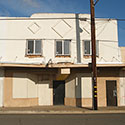
The Hiroshima Hotel's name presumably arose from the fact that many of Lodi's Japanese residents emigrated from Hiroshima prefecture. Until the late 1910s to 1920s, most Japanese immigrants were single men, many of whom found themselves joining California's migrant labor pool for agriculture. Hotels and boarding houses provided a base from which these men operated for weeks or months at a time. Sometimes called "blanket carriers," these workers spread word of jobs and places to stay to other immigrants as they followed crops. The Hiroshima Hotel was owned by the Masui family before WWII. Katsuyo Masui ran the boarding house and card room there until her death at age ninety-one.
Originally the Hinode Store, 4 Main Street was one of the first Japanese-owned businesses in Lodi. Opened in the early 1890s, the store sold goods to Japanese workers and Caucasian farmers, who used the store as a place to contract for farm labor through its owner, Seijiro "Joe" Masui. The original wooden store burned within its first few years, and Masui built a new structure of cement bricks on the same location. By 1910, the Hinode Company fell into debt and closed and the building began its life as a boarding house. Tatsuno Tamura purchased the structure in the early 1930s and ran it as a boarding house and hotel, with a Japanese bath or ofuro in the rear. According to a 1980 interview with Ms. Tatsuno by Kay Fujita, twelve to fifteen Issei still resided in the hotel. Fujita wrote: "If it were not for Tatsuno Tamura and the Miyajima Hotel, these men would have no place to go. She still cooks every day for them as more of a favor than a business. Costs are $2.00 a night to stay, and $1.75 for lunch or $2.00 for dinner for a home cooked meal."
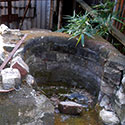
The Miyajima Hotel's current owner, Mike Smith, has renovated this historic structure as offices for his civil engineering firm. In the process, he uncovered artifacts related to the site's rich history, including a pair of stone objects in the garden. Smith speculated that these features might have been rice ovens, but at a walking tour organized by the Preserving California's Japantowns project in June 2007, longtime Lodi Nisei Nobi Tamura remembered that his mother used them as hibachis to cook sardines.
Named for one of the area's most profitable crops, Tokay table grapes, this restaurant was one of five Nikkei-owned food establishments in Lodi's Japantown by 1940. Not far away, Main Street's sidewalk still holds hitching rings for horses dating back to the early 20th century. While participating in a Preserving California's Japantowns walking tour, Sumi Okuramura recalled her father used a horse and cart to sell vegetables along a route from Lodi to Florin. When he returned, sometimes the farmer would be so tired, he would be found asleep in the cart with his horse munching grass on the side of the road.
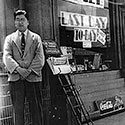
Druggist Sam Ouye had only recently married when he was forced to close his shop and leave for the Assembly Center at the San Joaquin County Fairgrounds in May of 1942. Ouye's Nippon Drugstore stood on Elm Street just a few doors down from the A.B. Fish Company at the corner of Elm and Main Street and on the same block as the Hayashi family's Union Laundry. Photo courtesy of Ralph Lea.
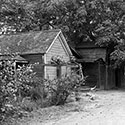
Nikkei leased, sharecropped or owned nearly two thousand acres of land around Lodi that was cultivated for grapes, vegetables and sugar beets. While residents of Japanese labor camp were primarily single men, a growing number of Japanese families built lives on farmland around Lodi during the 1920s and 1930s. The Japanese Association helped to circumvent restrictions on Japanese land ownership through forming the Lodi Association, which leased over 1,000 acres to twenty-nine families by 1926. In her memoir, To the Land of Bright Promise, Chiyo Shiyamoto recalled the ingenuity her parents and other Issei farmers demonstrated in designing and building equipment from scrap metal and used lumber. The image above of a Lodi area Japanese farmhouse and vineyard was captured by Dorothea Lange shortly after evacuation. Photo courtesy of Bancroft Library.
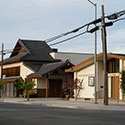
Directly to the east of Japantown’s commercial core, the Buddhist Church on Stockton Street was the only formal religious organization for Lodi’s Nikkei. Beginning in 1906, small groups of Japanese men traveled to Buddhist services in Sacramento and then Stockton. In 1929, the Buddhist Church of Lodi was formed and raised $3,000 to purchase and remodel a former lumber mill at 23 Stockton Street. Attorney George Steele, Mayor of Lodi at the time of evacuation, oversaw the Church property during WWII, and the church served as hostel in post-war period. The former lumber mill was replaced with a new building in 1955,which was extensively renovated in 1993, and stands today next to the 1964 Annex Building. The Buddhist Church of Lodi, and the JACL Hall across Stockton Street, remains as a treasured gathering place for Japanese Americans and host to the entire community at the annual spaghetti feed and Obon festival.